What Turns a Powerful Model into a Research Method
We've been working with generative AI since the earliest days, experimenting with GPT-3 in beta long before our industry had reason to pay attention. So, when we talk about AI for research, we're drawing on years of learning how to make it genuinely valuable for the work our clients depend on.
Most companies adopting AI offer the same thing, straight from frontier labs like OpenAI and Anthropic: a general-purpose tool that quickly consolidates data into a compelling output. That isn’t enough in a market as regulated as healthcare.
Our clients need an AI whose outputs they can trust and defend under regulatory scrutiny. We built that trust by engineering the research process into how inVibe Agent approaches data: a step-by-step workflow for it to follow and for us to audit.
Hand the inVibe Agent a set of patient interviews, ask for the most important findings, and you get a clear, grounded answer: the themes that matter, the patients they came from, the evidence underneath each one, and an executive summary your team can act on.
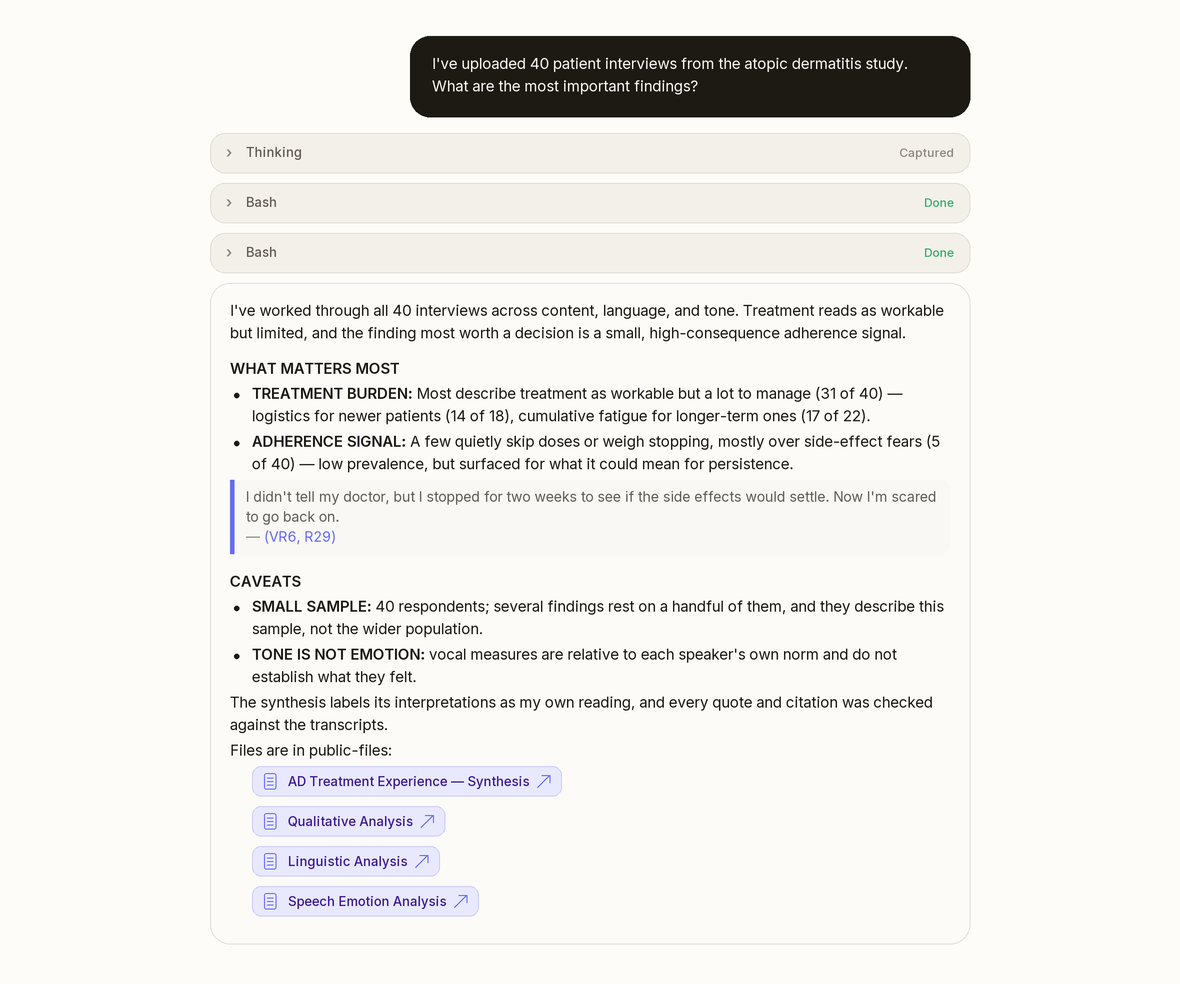
inVibe Agent returning the most important findings, ordered by consequence, with prevalence, a flagged minority signal, and caveats.
We Start with the Voice
We take our role as a listening company seriously. It’s why our research team is made up entirely of linguists, and why we ask respondents to speak their answers rather than type them. We analyze how people actually talk about their experiences, the words they reach for, the way they frame a worry, where they slow down or circle back, not boxes they checked on a form.
Listening lets us uncover richer insight into beliefs and attitudes, making the ‘why’ explicit in participants’ speech. We’ve built our Agent to approach data the way a linguist would, attending to what people say, how they say it, and how it sounds.
We keep those layers distinct on purpose. Language and the sound of a voice can enrich a finding, but no trained linguist would mind-read beyond what was said, and our Agent shouldn’t either. The workflow defines what it can see and what it's allowed to conclude, and that discipline is part of why the analysis is trustworthy.
The Expertise to Know What’s “Important”
As experienced life sciences professionals, we all know that market research and clinical research have language and jargon all their own. When we ask for the “most important” findings, we have something specific in mind, and a big part of our craft is making sure the Agent pursues what’s important to all of us in the field.
“Important” could mean the experiences the most patients share. It could mean a rare barrier with outsized consequence, the one thing that keeps someone from starting treatment. It could mean something patients seldom say outright but reveal in how they explain their choices. Each reading leads somewhere different. So, when patients discuss the burden of staying on treatment, a disciplined workflow has real work to do:
- Establish how broadly the concern actually appears;
- Separate common concerns from less common but consequential barriers;
- Compare relevant patient groups rather than flattening them together;
- Look for the evidence that complicates the emerging pattern;
- Preserve the conditions and qualifications in what patients said; and
- Choose quotations that represent the finding rather than merely dramatize it.
Each step reflects a systematic choice about what good qualitative analysis requires. Our language experts made those choices explicit, and we engineered them into reusable workflows the Agent applies just as we would, every time. Building in that expertise is what turns the capable models everyone can access into a workflow that consistently understands the ask and delivers on it reliably.
AI That “Listens” Like a Linguist
Let’s look at a few examples of what inVibe Agent can do:
- Qualitative analysis describes what participants said, with prevalence and source evidence attached.
- Linguistic analysis examines how they said it, the contrasts, qualifications, and recurring patterns that shape an answer.
- Speech emotion analysis uses the acoustic character of the voice to measure respondents’ emotionality toward key topics.
- Topic analysis organizes related ideas together while keeping meaningfully different ones apart.
- Saturation analysis looks at when genuinely new information stops appearing across a set of interviews.
- Verbatim selection chooses a quotation for how well it represents a finding, not just how striking it sounds.
The Agent's job is to understand your question and bring the right skills to bear in the right order, combining them when needed. Your job is simply to ask, in plain language. Everything we've learned about analyzing voice data is packed into those skills, ready to help you uncover richer insight by listening like a linguist.
Engineering the workflows well is only half of what makes the Agent trustworthy. The other half is proving it works, the focus of our next post.
Want to See the Difference?
Interested in learning how inVibe is building research expertise into AI-enabled analytical workflows? Contact our team to explore the capabilities available to clients throughout an active inVibe project.