The Testing Behind Every inVibe Agent Workflow
A clean, confident AI answer can arrive looking finished before it has earned your trust. Tidy structure and fluent prose can sit on top of a missed subgroup, an overgeneralized theme, or a quotation that's memorable but unrepresentative. In our last post, we discussed our approach to solving this issue: creating best-practice workflows.
It’s not enough to just recreate the process we learned in graduate school or in our years of experience in healthcare research. The workflows we create need to earn their place on your dashboard by doing one thing: performing the specific research job they were designed to do, proven against work our experts already understand.
Let's walk through how we make sure our AI workflows earn that trust, every single time.
Start With What We Know
There’s a truism in the AI community that large language models (LLMs) provide incredibly accurate outputs across subjects… except those where we’re experts, where they always seem to be wrong. Simple as it sounds then, the most reliable way to judge a workflow is to give it data we already understand thoroughly. We take research our experienced linguists have already worked through, hand the workflow the same source material and a defined task (without the human conclusion attached), and look closely at what it produces.
Picture an established analysis that surfaced treatment burden across a patient sample, with an important distinction: recently diagnosed patients focused on the uncertainty of fitting treatment into daily life, while longer-term patients described the cumulative effort of sustaining the regimen over time.
Any frontier LLM (ChatGPT, Claude, etc.) will be able to detect mentions of “treatment burden” and the specific ways in which it is discussed. The question is whether it can detect the consequential pattern, preserve the distinction that gives it meaning, back each group with evidence that genuinely represents it, and resist making either group sound more uniform than the interviews justify. That's the bar our workflows must clear faithfully and consistently.
Our Language Experts Make the Call
Judging whether this bar is cleared is expert work. Deciding whether an analysis quietly flattened a meaningful difference or leaned on a vivid voice at the expense of a more typical one, takes the kind of linguistic and methodological judgment our language experts have spent their careers developing. So, they're the ones who evaluate whether a workflow's output holds up as research, not how well it reads.
And we don't stop at the comfortable cases. The real test is what happens when the easy answer is also the wrong one: a serious barrier raised by only a few participants, two groups using similar words for different experiences, a finding that holds in general but breaks under an important condition, a quotation that only lands when unstated background context is brought to the fore.
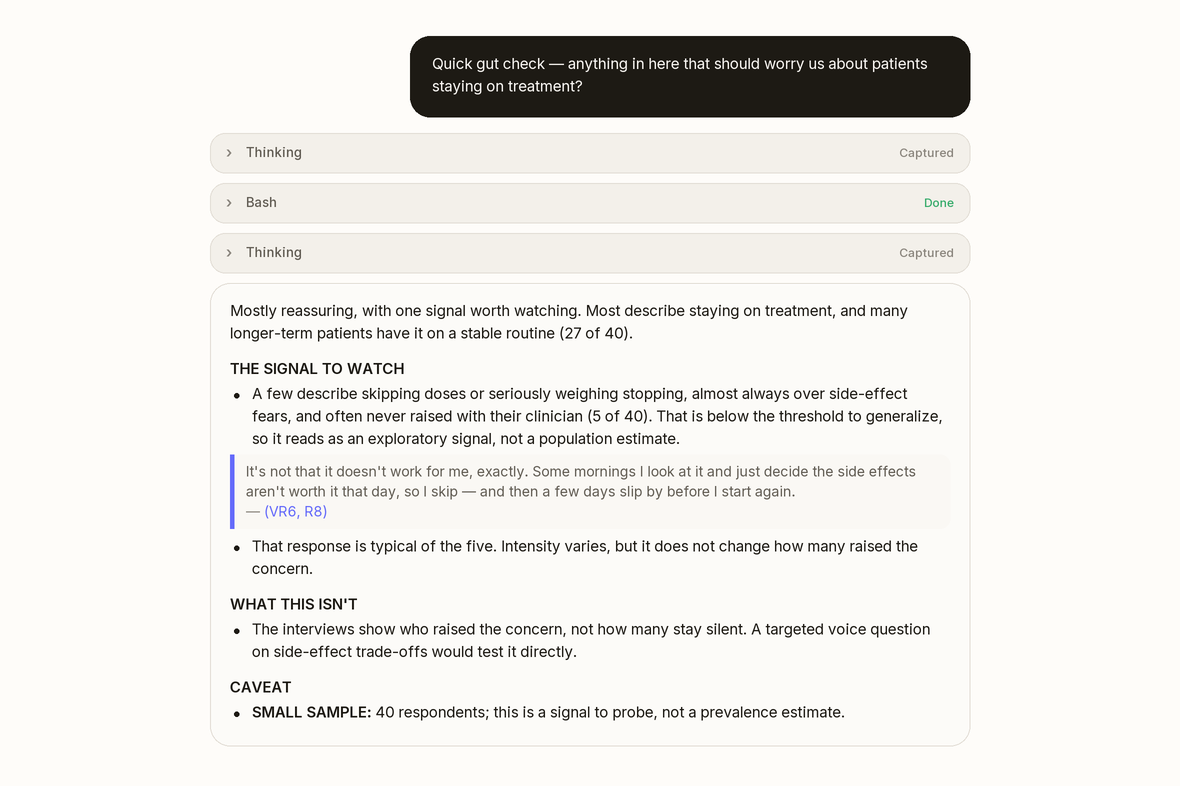
Our Agent flags a minority signal without overstating it, providing a disciplined answer on a hard case.
We also look at consistency, asking the same work of a workflow more than once because the wording can change while the substantive findings should hold steady. Yes, we’re “burning” tokens in the process, but the results speak for themselves: when a workflow reaches your dashboard, it has been built around a defined analytical job and proven on that job against work our experts already trust. That's the confidence we build in before it ever reaches your hands.
In our next post, we’ll look at what becomes possible once those tested workflows are yours to use all project long.
Want to Learn More?
Interested in seeing how inVibe evaluates AI research workflows against expert analysis? Contact our team to learn more about the testing behind the analytical capabilities available within active inVibe projects.