Just Ask: inVibe Agent Workflows Just Work
A few days after a report readout, someone almost always thinks of the question that isn't in the report. If treatment burden matters, does it take a different form for newly diagnosed patients than for people who've managed the condition for years? Which patient language would make that difference clearest to the creative team? Did participants mention a barrier that the brand or patient-engagement team needs solutions to address? Traditionally, chasing a follow-up like that means reopening transcripts, finding time (or stealing it from other deadlines), and starting another mini-analysis.
In this third post in our ongoing series, we focus on how inVibe Agent can help you to provide trustworthy, evidence-backed answers to your team’s questions. When you partner with inVibe, you can instead just ask the inVibe Agent in the way that comes naturally to you, and follow it through to analysis, evidence, and something your team can use, right when the question is fresh.
You Bring the Question
When working with an AI, you shouldn't have to translate a research question into technical instructions fit for a language model or to figure out how to break out your question into its component parts and determine which analysis to run first. You should be able to ask whatever is on your mind in plain language, the same way you ask a research team via email. By building in workflows central to how our linguists analyze data, our Agent works out what the question actually requires to find an answer, then coordinates the right skills against your established project dataset.
Let's follow that treatment-burden question from our last post and watch it happen. No special prompting here. We’ll just ask, “How do recently diagnosed patients (less than 12 months ago) discuss the burdens of treatment compared to those diagnosed more than 1 year ago?”
Our Agent Brings the Method
To answer it well, our Agent finds the relevant discussion even where participants never used the phrase treatment burden. It separates newly diagnosed and longer-term participants using the project's actual sample information. It compares what each group described without turning a few interviews into a universal difference. It examines how each group talks: the qualifications, time references, and narrative shape that carry meaning beyond the words. It can surface how each group sounds, drawing on inVibe's machine-learning acoustic analysis of the voice, as context for how an answer was delivered (never as proof of emotion, intent, or truthfulness). And it pulls typical verbatims that clearly exemplify the key distinctions.
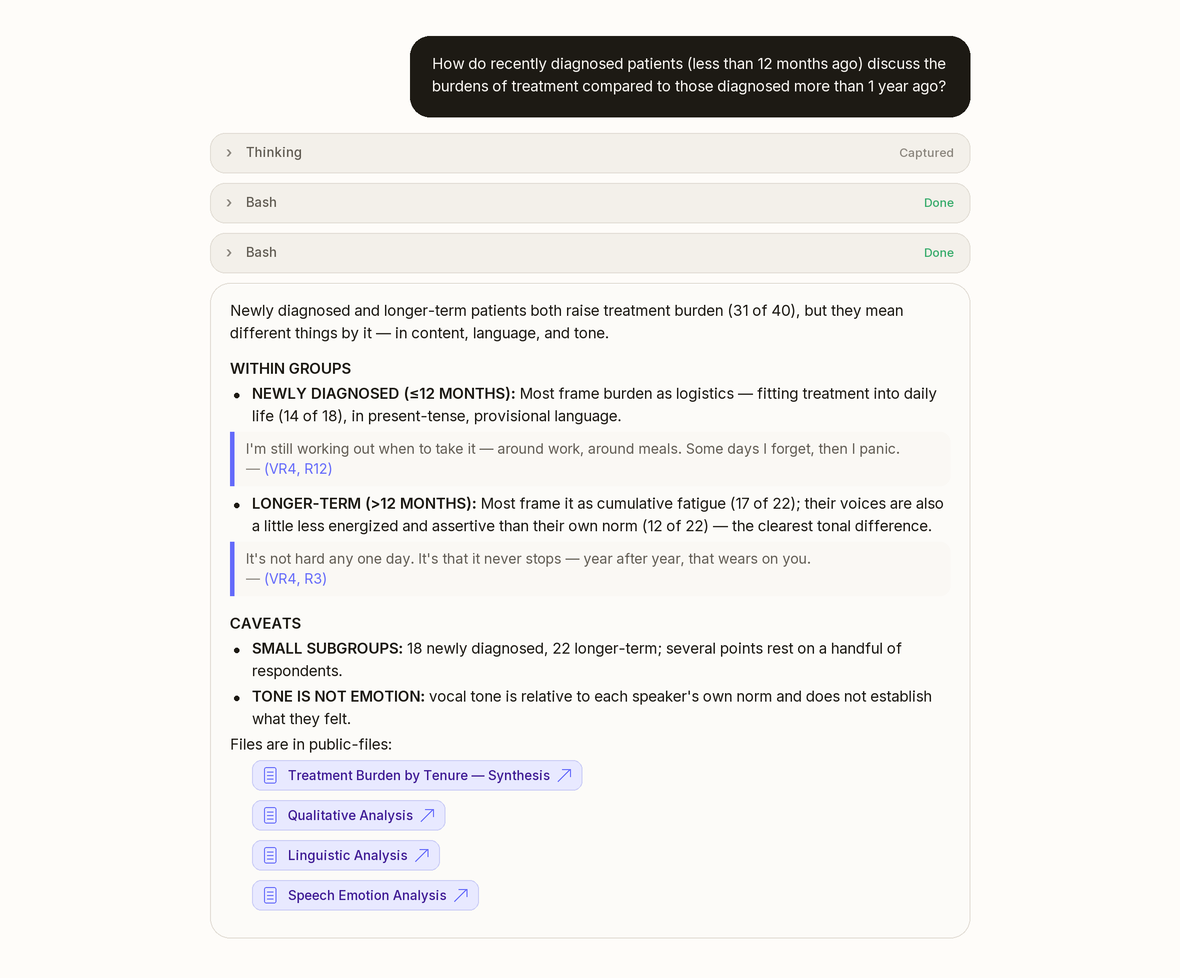
One plain-language question with an honest, evidence-bounded response, answered across content, language, and tone.
That one plain-language question quietly drew on several established workflows, and you didn't have to know that. You just had to ask, and our Agent brought years of voice-research expertise to bear on your answer.
We Set the Guardrails
Asking a new question of your project (or across projects) using our Agent makes more of your existing evidence reachable. It doesn't make the dataset omniscient, and that's exactly how it should work. If participants were never asked about a topic and didn't raise it on their own, our Agent won't fill the gap with a plausible-sounding answer. If a subgroup is too small to support a comparison, it describes the limit instead of manufacturing one. If the project can support an exploratory observation but not a firm conclusion, it keeps that distinction intact.
Effectively, we require our Agent to respect the limits of the data to which it has access. So, instead of a compelling-but-suspect response like other LLMs, our Agent tells you what evidence is present, explains what remains unknown, and helps you shape questions for a future voice survey. Material findings stay connected to the participants and verbatims that support them. A team member can check whether a quote is typical, inspect a counterexample, or challenge the way a subgroup was described. Knowing where the evidence ends is what makes every “yes” worth trusting.
So, the workflows are expert-built, proven, and yours to use whenever a new question lands. And they don't stand still — they keep getting better. In our final post in the series, we’ll focus on why. (Hint: it has nothing to do with the ever-increasing version numbers and brand names you see after AI models.)
Want to Learn More?
Have a follow-up question that emerged while applying the findings from an active project? Contact the inVibe team to learn how our AI research agent can help you revisit the project evidence, conduct additional analysis, and turn what you learn into something your team can use.